Wednesday, 15 August 2012

Bangalore Lal Bagh Flower Show


Bangalore Lal Bagh Flower Show


A day out at Lal Bagh Flower Show!

After about 35 years, I entered Lal Bagh. To witness the Flower  Show for the first time. Climate was holiday-friendly, sun playing hide-and-seek with patchy clouds.  It was a working day, yet I entertained a tourist-laziness in me.


I collected the entrance ticket  from the counter-staff ( I could spot a rare smile sported by the guy behind the counter, probably the flowers in Glass House must have influenced him).  I was in the Glass House at 9 a.m.


What did I see?  How did I feel?


Visually Exciting. Inspirational. Dreamy.  These are just a few words that begin to describe the Bangalore Lal Bagh Flower Show. Flowers.Colors.  Flowers.  Children. Flowers.  Beauty. Flowers. Music. Flowers. Space. Flowers. Photography. Flowers.  Holiday.  Flowers. Freshness. Flowers. Climate. Flowers. Nature. Flowers. Tourists. Flowers.


Basket of flowers, yes, we are familiar with! A Glass House full of flowers in all colours, sizes, shapes, designs. Wow!


Going round and round inside the glass house, not  feeling the pungency of redundancy!  I am not a Botany student to give all the names of all the flowers on display, except what I could manage like roses, orchids, marigold, jasmine ....


While the floral show IS a photographer's delight, be it a professional or a dabbler, I befriended the young and enthusiastic Apoorv  Dutt, an upcoming professional  lensman who volunteered to assist me with a few of his snaps, which you are seeing here.


Steadily, school children started streaming  in with their musical noise, adding color to the colorful mood and ambience.  A mix of culture with foreign tourists revelling the atmosphere. “ A thing of beauty is joy for  ever” John Keats must have said it visualizing the Bangalore Lal Bagh Flower Show.

“Designs of display in the Glass House undergo a change every year” said a lady who was having a tough time to control her naughty  child.  She gives active attendance every year to the show.


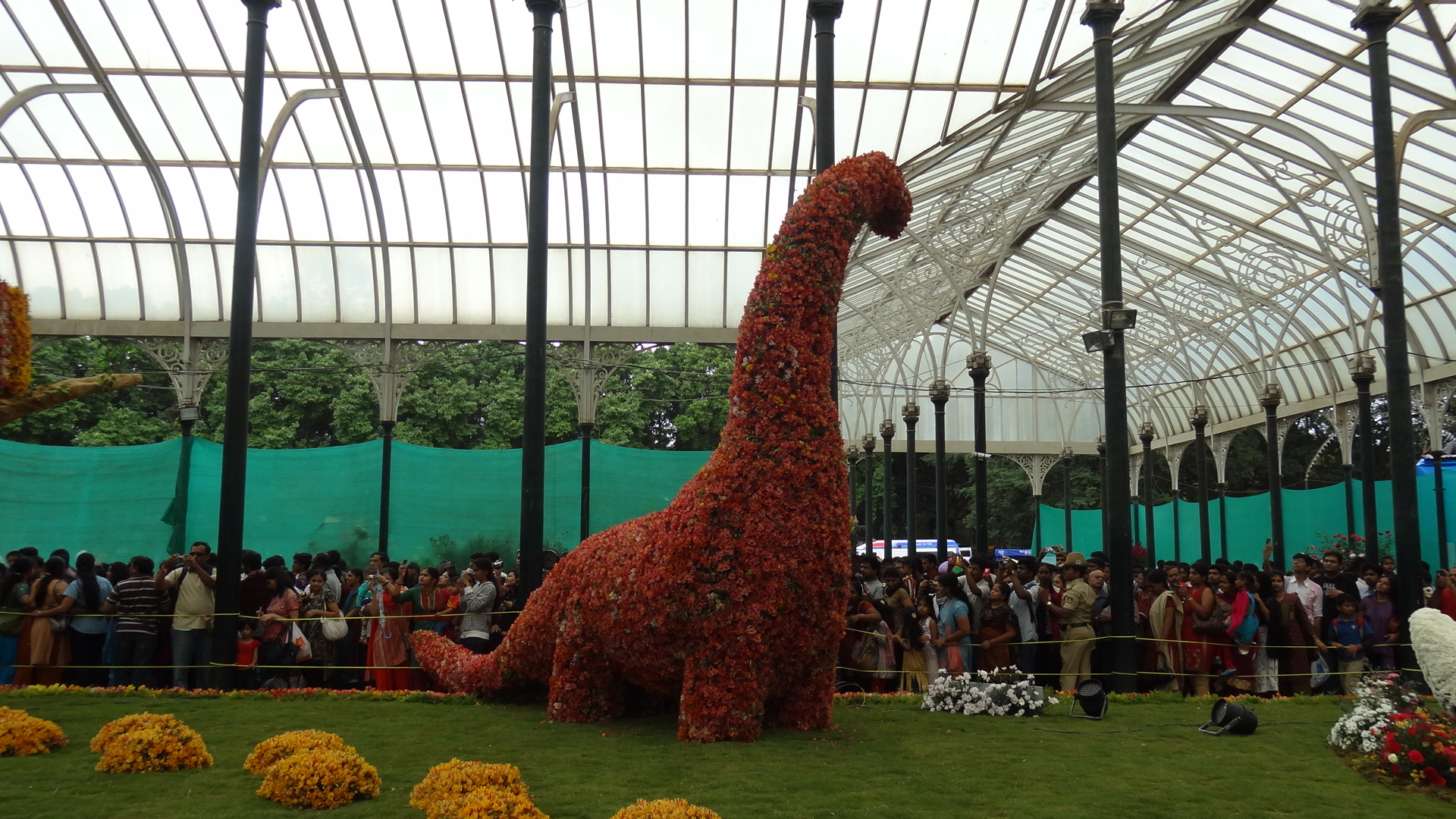
Pink Dinosaur and Tree House are star attractions of this year.  "Animals" is the theme of this year's Show.

Mr. Rajan, a hobby-photographer, has been visiting for the last 15 years.  “It has become commercialized.  There is increase in population, pollution, traffic…….  Tree-felling is becoming a more frequent happening.  In spite of all these, the annual event is a phenomenal success”, he said.


The flower show was stunningly amazing. The garden is about variety blended with fantasy, yet a reality.

Lal Bagh – the right place in Bangalore to get inspired to go green.


Security arrangements at the venue:  Visitor-friendly.
Emergency medical help: Available


One last word: If you have not seen the flower show even once, make no mistake! You will be retrospectively regretting like me for not making it earlier! The Show has to be seen to  be believed to be enjoyed to be experienced!!!

There is no Bangalore without Lal Bagh!  And no Lal Bagh without Flower Show!


Sunday, 12 August 2012

Salute to the special talent! Good-bye Olympics 2012!


Salute to the special talent! Good-bye Olympics 2012!


“My coach expect the same from me as from anyone else”, says Poland’s Table Tennis star Natalia Partyka,  who was born without a right hand/forearm.   " I am playing  the same lines as the others.  And I have the same dreams and goals" who refuses to use disability as an excuse. Natalia began playing TT at the age of seven. She is such an inspiration and doesn’t let her disability slow her down.  At 11, she qualified for the 2000 Paraolympics in Sydney and was the youngest athlete to compete in any sport. Four years ago in Beijing, she competed in the Olympics and won a gold medal in Paraolympics.  Her Polish team-mates said Natalia made the sport more popular in their country. 

She has done with one hand tied than most do with both hands. A fabulous story!

Oscar Pistorius, nicknamed ‘Blade Runner’, representing South Africa, sprints to glory  to become the first double  amputee to compete the Olympic games. The 25-year old runner was born without calf bones and his legs were amputated below the knee before he was a year old.  His courage, persistence and drive to overcome his disability is spurring. A real champion reflecting the triumph of the human spirit!

Natalia has been particularly interested in Pistorius story because she can relate on some level. “I think both of us can make a difference, especially disabled people, to prove we can be top-level athletes and compete against the best.  There is no need to feel inferior”.

Many people with disabilities, we are aware, have contributed to society. The first name comes to  mind is the Nobel laureate Albert Einstein (remember,  the theory of relativity?) , John Milton (“Paradise Lost”), Thomas Edison (does it ring .... bulbs and the telegraphic system?)…... Take our own Sudha Chandran, the Indian actor and classical dancer, who bravely dances with a Jaipur foot.  Of course there are also plenty of people worldwide who may not be famous in the sense society deems famous, but still live with, battle, and overcome their disabilities every single day of their lives.

The fact of disability is a permanent pain for those who feel, but for those who think, it is a challenge to rise above the limitations. Life has never been equal for everyone, and for those who have dared to conquer their challenges it is all but glorifying to their resilience.  It is stimulating that even people with disabilities can achieve remarkable recognition and make immaculate impact.

One thing is clear. After reading about famous people I realise that challenge is the foundation for greatness. Attitude is everything. Life isn't about waiting for the storm to pass... It's about learning to dance in the rain.
From their side they prove they are heroes and performers, teaching you and me that physicial imperfections are insignificant. 

Let's come to the conscious side.

On seeing a handicapped person, our first impulse may be to look the other way, avoid eye contact and keep walking. A person struggling with serious illness or confined to a wheelchair can be a painful reminder of how vulnerable our own bodies are and how uncertain life can be.  Isn’t it that a disabled person is a person first, the disability is only next?  Think about how you would want to be treated if you were among them. You know you would want to be heard and valued. A simple example, when you post a message in Face Book, you want maximum "likes and shares".

They are usually more fragile, their heart may be easily broken. Learn to walk in their shoes on a daily basis.  When you can learn this you'll have learned a lesson about compassion.

Does society offer much help? Obviously, it is you and me, I mean by society. This reminds me of a type of response some of us entertain:  The moment we sight a  person with special needs, we are taught that it is the "karma" or some sins committed in the previous birth. What is our response in the case of 'disabled'(?) heroes who have astoundingly outperformed and outlived many of the so-called normal human beings? 

Look at the Olympic victors. If the flame of passion is burning inside your heart and mind, nothing can stop you from reaching your goal! Truly an inspiration for anyone who has ever questioned why things happen, what his/her purpose in life is, and may have even considered giving up! The message is plain and simple. NEVER give up - You ARE special and your life DOES HAVE meaning.

In many ways, society helps everyone learn how to mature and how to face the world. Open any book, watch any film, listen to any conversation, and you get a glimpse of how someone without a disability is handling life. But how often does a person with a disability get to share the feelings and experience of someone in the same predicament? It is a goal-oriented life and people with disabilities live very much in the moment.

Anyone who has ever observed a physically disabled individual will simply marvel at how he/she manages to maneuver himself/herself around, in and out of cars, through doorways, in restrooms...

Every other person with a disability, wish he/she could be appreciated for who they are and what they can do.  They learn to plan and control their world in new ways. In short, they cope, find new values.  The negative change in body brings about a positive change in person. More than emotional, they inspire us to follow our dreams and passions.

While we bid good bye to Olympics 2012, heroes like Oscar Pistorius and  Natalia Partyka have, undoubtedly, redefined the notion of handicap. 


Saturday, 11 August 2012

Is boss a bad word?


 Leadership is action, not position. - Donald H. McGannon


My first impression about "boss" is to recall the villains of yesteryears  from whose mouth cigaratte will be hanging, wearing a  hat and dark glasses (day or night), turning around a swivel chair with hand rests, sporting a maniacal and loud laugh, holding glass half filled liquor, surrounded by about half-a-dozen sycophants......  We call our superiors "boss," and  it became a part of the everyday English lexicon. No wonder the title sits pretty on guys who derive pleasure by causing troubles to good folks in our film stories and in our work-spots too!

This is not to hammer out that boss is always wrong, but certainly boss is not always right.

We all have started out at some level lower than what we are today in our jobs. I have been lucky to have had mostly good bosses in my working life.  If you are accustomed   to  good boss, then having a bad boss is all the more difficult to cope with.
                            
Dhoni, the Leader
Boss
                                                           
I, nevertheless, interfaced two toxic bosses. To rewind:

1) I began my career in a rurban (yes, you are right, it is semi-urban) branch of a nationalised bank. The practice in that branch is the new-comer will work beyond office hours not to just complete his day's work but also clear up the "pendings" of the other co-workers, of course without any overtime/compensation.  This will go on for six months when the probationer will be, in the normal circumstances, confirmed into the permanent services of the bank.  From then on he will walk out royally at 5 p.m., thanks to the support of the trade union/s.  But to the likes of the management, the next probationer will invariably carry on the relay.  After my confirmation, one evening during an informal chat, I curiously asked my boss(?) why they treat the probationer like a bonded labour?  Pat came the reply: "Yes, I exploit and will continue to do so, because I was exploited and have to give it back!”.

2) Mr. Harjinder Singh (name changed), the Indian boss (Branch Manager of Wealth Management Division of a local bank in Dubai), clearly did not know the meaning of “value date” in banking parlance.  Being a banker, to term his ignorance “absurd and ridiculous” is to say the least.  One fine morning   I entered his cabin with a customer account statement. A credit entry relating to a clearing cheque deposit shows the current date (date of deposit) and underneath it showed the “value date” which is date of the next working day. While he insisted that the available balance includes the cheque in question deposited on the current date, I made  valiant attempt  in vain to make him understand that it was only the ledger balance and would become the available balance only the next working day subject to clearance of the instrument. In the normal course, I would not have had any problem in making an 8th grade student to understand. But our 'hero' would not lend his ears.  There was a keen contest as to who is taller - his ego or  his ignorance.  He shouted at the top of his voice at me; "Don't teach me banking.  I have come to this seat not to learn from you!....." I remained tight-lipped and left his cabin as if I chewed a bitter pill. The beginning of the strained bond!  I survived, of course, at the expense of my next grade.

3) In another case, I have known of a guy in Dubai who complained about his boss to the top boss about some fishy transaction.  The next day, the boss called the guy and flung the e-mail printout of the complaint originally mailed by the guy to the top boss.  "You have come to this country to make money.  If you have other ideas, get ready to join your family back home!"  Of course, the guy sadly had to fly back home!

You say, “boss I think…..”  The boss quickly responds, “when I want you to think then I will tell you!” Hundreds of such true "bad boss" stories would emerge, as you discuss with any  person next to you. I leave it to your thought the kind of boss you encounter(ed) in your career.  Of course, it could be you are a giver, if not a receiver; or even, like the first case quoted above.

Having a bad boss can be a very trying event .  They come in all shapes, sizes and genders.  The worst is when your boss's insecurity gets the better of him.  The insecurity is 'justified'  when he is not hired based on merit, but on his connection (like Mr. Harjinder Singh).

Cases are aplenty where one gets frustrated after a lot of dedicated and hard work, the boss still yells at you when he feels insecure about something, with no appreciation, let alone recognition.  And promotions... again wait for another year.  Subordinates are strong only when they unite ... but then it leads to another scenario of "UNION" which is slowly fading.  It is not easy, but not impossible.

You can't control the "bad" boss behaviour but you can make it clear in a professional manner that you will not accept their bad behaviour towards you (but easily said, rarely executed).  It may be possible to remove a bad boss, but beware - your health could go for a toss, and your career goes nowhere until you get another job or a better boss. After all, the boss remembers all my bad things than the good things

Of course, you may try to help your boss to achieve his goals, understand what he/she values - like is he a paragon who has a penchant for details, showing a sense of urgency...  He is not made a reporting authority for nothing (of course, his proximity to his boss can also be due to personal or biased reasons).  He worked his way up the ladder for this privilege.  Not every human is unreasonable, only situations make him or her that way. As a subordinate, try to be proactive and address the situation. Ensure that your good work does not escape the eyes of your boss as at time one must “blow their own trumpet”.   Conversation, official and otherwise, will be artificial and absolutely against conscience.  Though outwardly I used to say "Sir, this is the best tie I have seen you wearing!", whereas inwardly I used to spit at myself feeling grossly ashamed for cheating my conscience.

Life is always not fair. If your boss is determined to screw you, anticipate it and be prepared to accept it. There is no escape. Working is a necessity and not a luxury for most of us.  With the economic volatality, jobs are not as easy as the picking, particularly wherever the 360 degree appraisal is not the in-thing.  Learning how to and how not to lead or manage is something you learn from every boss.

Is it that boss and ego are made for each other, if not synonymous?  If the boss is good, I think we should title him a leader. Can we equate boss to a politician and leader to a statesman?  And if leader is bad, call him/her "boss".  "Boss" sounds unprofessional?

To end this feedback on "boss" (which can of course always be continued tirelessly) with a joke an old colleague shared with me recently : What do bullies and sperms have in  common? They both have a one-in-a-million chance of becoming a human being.
      
                                                                      =======


I invite your feedback to my mail id: krs1957@hotmail.com


Friday, 3 August 2012

Book Mark: Rahul Dravid – Timeless Steel


Book Mark:  Rahul Dravid – Timeless Steel


Before even opening the book, my first impression is Rahul Dravid himself is a book. A career of the greatest ambassador of modern day cricket spanned with glorious, yet disciplined chapters! 

A collaborative effort of Disney and ESPNcricinfo,     "Rahul Dravid - Timeless Steel" is a noble collection of write-ups of what great stalwarts and writers like Greg Chappel, Sanjay Bangar, John Wright, Rahul Bhattacharya ..... think about ‘THE WALL’ and what the Indian maestro thinks about the game.  Articles, interviews, pictures... You can pick up any story, not to insist on continuity and read at will.  While some of the articles you might have already read, it is nevertheless  a satisfying page-turner  without much technical stuff and the  compiled hard-cover takes you through a pleasurable journey.

Suresh Menon in his  "The Talent Myth",  comprehensively convinced the reader when he countered Sanjay Manjrekhar's subtle doubts about Dravid's "talents".   Sanjay : "...you don't need to have great talent to become a sportsman is reinforced by Dravid's achievement".

Retorting to this as one of sport's big misconception, Menon went on:
"Fifteen years at the top level without talent? Over 10,000 runs each in two forms of the game without talent? Three test centuries at 39 in England without talent?...........  It was all about anticipation and positioning  rather than flamboyance and showmanship.  It is called talent."  I don't remember, any time later, Sanjay made any comment on talent, least of all Dravid!

Rahul Dravid, the first Indian to be invited to deliver the "Bradman Oration" (a classic inclusion of the book), harmonised multiple aspects of human existence without losing sight of his core competency - cricket.

The book goes on to show the respect and admiration he commands from one and all. With interviews of former India coaches, his childhood friends, teammates, noted sports journalists  - the title offers great perceptions into the personality.  The book gives plenty of hidden insights that makes him a complete human being, professional and personal.  A genuine embodiment of the best traditions and values of the game!

While the 256-page collection of 30 write-ups is a tribute to one of world cricket’s top legend, it is very much a book on the Indian maestro that brings out the  stories of struggles and sacrifices, relives the great victories and defeats, bidding to showcase the sincerity of Mr. Dependable.

Well, is the penmanship incomplete without an eminent literary prose of Harhsa Bhogle? Just a thought!

A few sparkles from the text:

"Sachin Tendulkar was India's batsman of the '90s; Rahul Dravid made the 2000s his own". 
"There is a normalcy about him that is almost abnormal". (Sambit Bal, Editor, ESPNcricinfo)

"Watching him bat was like watching the movement of an old-fashioned clock: the pendulum working, gears and levers moving in perfect, elaborate accord to strike the hour when it is due and not a second earlier". (Mukul Kesavan, A writer based in New Delhi)

"In the trinity of Indian batsmanship - Sunil Gavaskar, Dravid and Tendulkar - each had a defined (and defining) role. They were the Creator, Preserver and the Destroyer respectively.  Dravid was as tough and as professional as they come, yet with a moral centre that was uncompromising". (Suresh Menon, Editor, Wisden Cricketers' Almanac)

"Dravid's basic talent can be found in many, but what has made of it is the rare, almost unbelievable, Dravid story". (Sanjay Manjarekar, Former India batsman)

"In cricket, as in life, it is not the most talented who  survive, nor the most intelligent, but the ones who are most responsive to change. Dravid's career was an eternal quest to get better". (Akash Chopra, Former India opener).

"I always treat nets as a match. I really hate getting out in the nets. I create the sort of intensity that I would need in a match. Driving and edging in the nets is not okay with me". (Dravid in an interview).

"One word has attached itself to Dravid wherever he has gone; gentleman.  He is a man of substance, morally serious and intellectually curious". (Ed Smith, Former England player, and shared dressing room with Dravid in the English county)

"Had he (Dravid) been given the same whole-hearted support in the role he had given others, I think the history of Indian cricket may have been very different and he could have gone to become the most successful Indian captain ever". (Greg Chappel).

 “Dravid could play attacking cricket like me, but I could never play like him”. (Chris Gayle)

"He does not have an ego and can easily concentrate on the next ball after he has been beaten by one". (Sanjay Bangar, Former India Player).

"It was difficult at times for me to  decide who was better: Rahul Dravid the human being or Rahul Dravid the cricketer". (Fazal Khaleel, former Karnataka player)

"The caricature often made of Indian cricket and its cricketers in the rest of the world is that we are pampered superstars - overpaid, underworked, treated like a cross between royalty and rock stars.......
"Disrespecting fans is disrespecting the game".  (Dravid in the Bradman Oration).

If you are a cricket lover, straight away start reading!
If you are a Dravid  fan, buy, read and treasure!!

http://kmurthy608.blogspot.in/2014/05/cricket-where-is-gentleman.html
http://kmurthy608.blogspot.in/2012/08/catches-win-matches-yet-fielder-is.html
http://kmurthy608.blogspot.in/2012/06/open-letter-to-sachin-tendulkar.html

Friday, 20 July 2012

Say A Resolute No To Corruption, says Justice Hegde !


Say A Resolute No To Corruption, says Justice Hegde !

Former Lokayukhtha Justice Santosh  Hegde called upon the student community to fight for ending corruption in society.


"I have come not to ask for votes, but to seek your support to fight corruption" said  Justice Hegde (72) in his opening remarks.

Addressing the gathering of New Horizon College, Bangalore, on Thursday afternoon (19/07/2012) Justice Hegde remarked the “galloping speed with which corruption has surged in our country”. "In 1950, Rs.100/- was considered a huge bribe amount and only a handful of cases would be reported. Even the District Collector’s salary then used to be about Rs.300/-.  Just see the contrast – in 2010, 2Gscam alone accounted for Rs.176,000 crore even when compared to Bofors scam figure of Rs.64 crore",  he recalled.

“In 2008, Govt. of Switzerland made a public statement that banks in Switzerland has US$1,456 billion of Indian deposits.  Interest on this total deposit alone can wipe out Indian budget deficit plus all our foreign debt in 24 hours.  Supreme Court directed  the Government of India to take the money out, noting nothing much happened after it”, he said highlighting the enormity of the stash money.

Referring to the way our democratic system is functioning, “how many of us can boldly and proudly say this is my/our  government?" he posed.  This democracy is for some people, by some people and of some people”,  languished  the Justice.

Citing a parliamentarian’s remark in the House who questioned the “audacity” of the man (Anna Hazare) to call the Prime Minister, a public servant, the former Justice  said the nation does not belong to legislature, bureaucracy or judiciary, but to WE, THE PEOPLE OF INDIA.  “Who am I” will be the title when he writes an autobiography, he added.

He also observed the haste in which business was conducted in the parliament, mentioning  that “17 Bills were passed in Lok Sabha within 12minutes. Who discussed the bills? Fortunately  it did not go through in Rajya  Sabha”.

He expressed concern on the deplorable current state of affairs that continues even after 62 years of independence and urged the need for reforms on various fronts like, electoral, judicial, police and medical ... to name a few. He strongly recommended that the performance audit of the elected representatives must be drawn  and published; 51 per cent of the votes to  be polled for getting elected; not to be permitted to contest if there are any criminal cases pending against them.

A few sprinklers out of the Justice mouth:

-In the pornography episode  which "caught" three ministers of Karnataka, the then Chief Minister’s defence was that 23 opposition  also watched pornography.  Why not have a big screen on the floor so that all can see it?.. quipped the Justice.
-In government hospitals, go vertically and return horizontally!
-It takes minimum 10 years for the case of prevention of corruption Act when it comes up for hearing. 10 years is a long time, by which evidence would disappear.
- Currency is softer than corruption.
-Out of every rupee spent by the government only 15 paise goes to the actual beneficiary.
-Out of 542 members, only 192 spoke in the parliament.
-Corrupt people are not human beings – homosapiens of a man or woman
-Corruption is born with the birth of civilization.
-I am proud to make a statement that I am the only SC judge after retirement to have come to streets to fight against corruption.
-"Become anything you want to become, But first become human".

In his address, Mr. Prithivi Reddy, Core Member, India Against Corruption furnished data from the affidavits of MPs/MLAs: Out of 4,835 MLAs/MPs – 1,498 or 31 per cent have criminal cases against them; 50 lakh bogus ration cards detected in Karnataka.  "We live in cocoon, it could burst any time", Mr. Reddy cautioned, adding that "Patriotism is not just fighting a war, but fight for what is right for the country".

Mr. Mohan Manghnani, Chairman, New Horizon Educational Institution exhorted the students to actively take part in the activities of India Against Corruption.  Mr. Maghnani believes in having “multiple dreams and striving to fulfill them for a society free of corruption”.

Mr. Jawahar Mirazkar, Principal: “New Horizon provides a platform for its students’ overall development and grooms them to be able to face the real world”. On the social evil corruption: “I along with my college have been a part of the INDIA AGAINST CORRUPTION movement from the very beginning and intend to support it till the very end”.
==

Tuesday, 17 July 2012

Parties or Funerals! Jeans Are Forever!!


Parties or Funerals!      Jeans Are Forever!!

Odd to see someone, unmindful of age, gender, geography…..who doesn’t wear jeans.  Doubtful if anyone’s wardrobe will be without the denim fabric. Guys and Gals walk in jeans, talk in jeans, dance in jeans,  sleep in jeans…. Because it is durable? Material is thicker? Fashionable? Just casual? Feel privileged? Cute & Comfy? Stretchy & Sexy? Low maintenance?...... Could be any number of reasons? Or no reason at all? Just wear jeans!

A little more than an inquiring mind to pursue the details about the most preferred casual wear that will always be in vogue, led us to meet  Mr. B.J. Saiswarroop, General Manager, Zovi, Bangalore. 


Excerpts from the jeanterview:

Why jeans the most popular casual dress all over the world, cutting across gender and geography, reason and season ?
Jeans( layman's term), now  popularly known as Denims(technical term) is perhaps the best clothing mankind ever asked for, its for all seasons, no geographical undertone; more worn-out and it gets that much more fashionable and valued more as well, I’ve never come across any other fabrication that can most certainly be compared to an antique piece.

Do you see jeans as a mere casual wear or more than a fashion statement?
It depends on how you want to fashion your way with a Jean ..it can blend into both easily !!

 “Never wear  jeans for a job, no matter how casual the job is”.  Tropical spots do not help relish formal clothing for obvious climatic reasons.  On the contrary, they don’t present pleasant and also look over-dressed.  Why not sport a semi-casual attire? How about a nice-collared shirt with well-pressed jeans?
While denims have been associated  quite a bit with Friday dressing, personally I would want to wear it all the time, fortunately for me have always been associated with an organization that doesn’t dress formal, may be a clean look on the jean with a white shirt could be an ideal way of semi formalizing the office wear and accept it as an offshoot of  formal wear, extending this with an odd coat almost covers for a suit! it’s the thought process that has to change. Mostly, some section which I would recommend perhaps a little out of the box would be for school children, you can these days get a stretch denims which will make the life of playing children comfortable and yet can manage all the wear and tear!

What is your take on fashion in today’s scenario?
Whatever one’s comfortable wearing becomes fashionable as long as they can carry themselves with what they are wearing.

How was “jeans” accepted as an universally acceptable casual wear?
It dates back when the coalminers in the west took it outside their functional work place.   It became popular once this got out of and became a household overall suit and provided so much a protection first and it was long lasting too.  

What could be the percentage of jeans market compared to other casual wear? Do you see any competition to wearing jeans?
I haven’t seen another fabric developed which even comes close to a jean thus far, so it just stands out as the fabric you can die for when it comes to your wardrobe.  I would rate the jean market as a whole to a good 30-40 % in the Apparel world and its growing further with all the R & D happening  with it subjected to  variable washing all over the world.

“The longer you wear or the less washed, the more character and attitude they acquire”.
This argument is a little subjective as I would like to believe its horses for courses as an example in cold countries, it protects from the chill especially as a bottom wear, you can use it as a sustainable source and save water [ on a lighter note!!]  Out in India our summers are harsh, although we could still pull up a denim to quickly venture out ..esp.. if you are a man, I would still recommend to wash it after about 2 /3 alternate usage. As well as my earlier comment too, as they say with age you get wise, the denims mature with age dishing out.

Can you briefly tell something about the types of jeans – say, like classic fit, straight fit, skinny leg….?
As the world evolved and took the fashion alongside, different fits with stretch peppered in, gave denims another lease of life, it thus captured the imagination of all the contemporary designers who idolized denims and dished out another ensemble on its way to popularity.

Do you have jeans types for different seasons/geographic/climatic conditions?
Yes jeans/Denims come in different thickness, and functionality to cater to all the differential seasons, denims can come with a thickness starting from 3/5 ounce to one that gets up to 16/17 ounce, the heavier it gets its translated to more than a casual wear/trouser in particular…as we all know the jeans from its birth….there are drift moisture managed denims, there are denims which stretch 2 way/4 way too …denims that are bruised and battered which ends up eventually on the fashion podium.   

Recently I came across a pair of jeans (Levi’s) costing US$ 46,000/-.  Can you throw some light on the significance for such a staggering price tag?
I know for a fact that a polo tee in one of the L Capital-managed-high-end-store in Delhi costs about Rs 26k …in our Bangalore Levise stores the highest pair of jeans that I have seen is around Rs 14 k …..all of these prices make no sense so far as the material going in is concerned…perhaps some gold or diamond could be studded in place of the common rivets on the jeans, else it could just be a fashion statement made subtly and something which has a unique selling point as far as its attestation is concerned, it could have been signed off for a super model or perhaps a signature line with some popular actor statesman, politician  …..when people are rich enough to own a Picasso, I wun shudder to think in the recent times that  a pair of jean costing as much as $ 46 k would be a master piece, however that’s the way it works…I guess.     

How is the global market share is distributed?
Global market share is distributed in terms of tiering of brands and designer labels…say for instance Levise, Lee, wrangler are the primary denim brands with every other brand falling suit ..I can put a rough figure of  the first 3 capturing @least 60 % of the world market share and the rest filling in as an approximate measure.

How does washing, shrinking and bleaching makes an impact on the fabric?
Washing accomplishes shrinking  and is the integral part of the Jean. It’s the world of washing that does jeans the way it turns out to be ….in fact all of this started off with the indigo dye which under different wash conditions gives out hundreds of shades with most of the times is so typical that it cannot be duplicated no matter what sort of scientific recipe one would give it, Bleaching is also a part of the wash process where you would want a jean that is typically worn out of the indigo dye and renders the jean colorless. 

Are all jeans of the same basic quality? Why are they priced so differently?
The basic quality of the Jean is attributed towards its weight to start of and the kind of weave that it hold, the prices come in different simply because of the wash, which is the biggest value addition and of course the fit which people symbolize with ….I for one can swear by the Levise Fit and till date, while I have experimented, have not seen another brand that fits as good as a Levise. 

How will you be able to tell a fine-quality denim from a lower-quality denim?
Everything about a denim is determined by the wash it carries no matter what the weight of the fabric is.

What if you don’t want to spend a lot of money on a pair, but you still want a quality product (of course you are ready to compromise on the brand)- what characteristics that you would look for when you are buying the jeans?
I would first think about the fit as far as am concerned, after which I would look for the feel of the denim ..i prefer it nicely washed down and with  a soft hand, then I would perhaps look at the shade that it bring in …I prefer a gradual washed down effect to  the one which has too many patches and looks really busy when you wear it, secondly I don't think I can carry off the one which has too many finishes on it. 

Why some designs fade very fast?
Fading is part of a deal in denim, every denim is made to fade after a few number of washed and further more as part of its complete life cycle, some designs perhaps fade faster than you like it because it might not have been washed out effectively during the first stage of its transformation.

How can you help a common person identify a good pair of jeans from a duplicate one?
This one is not that easy, because theses days the knock offs [ duplicates are so well made]…however there are a few points where you want to look into like the zipper finishing and the belt loops on the outside and the finishing on the inside upper back as well as the pocket bags [ which are normally compromised by the fakes]….the rivets carrying the logos as well as the brand  patch at the back are give aways if you observe well enough.

When you say jeans, you instantly think of denim blue; why other colors didn’t become prominent?
That’s because indigo dyes which make up for the typical blue could not be replaced by any other color for long till another form of direct dyes were found out, after which all kinds of colors started to flow in

How is the export-market for Indian manufactured jeans?
The brands have typically made country of origins a mere pushover simply because the processes of making a denim all over the world with a particular brand is the same, the only difference is perhaps the price that is determined by the cost of manufacturing, else denims/their fits all over the world with a particular brand will be the same.

When you wear tight jeans (ladies in particular), squeezing into tight pants – does it cause numbness or leave a dark impression or any nerve compression or any abdominal discomfort due to ill-fitting clothes?
Tight fitting clothes do suffocate the skin to a large extent, however science has prevailed and technology has made life easier typically in the form of breathable fabrics where the air movement eases the skin and  renders the wearer less discomfort, and with stretch fabrics coming in skin tights  became more popular and they also made a fashion statement with the additional SLIM persona which typically would divulge  women’s curves.

Do you think that garment industry can initiate that jeans be projected as a better, clean and professional formal wear?
More than the garment industry I would think the fashion industry will yet change the name of the game in denim…there were so many occasions when we did sign off that denims will loose its sheen and will fade out….on the contrary our thoughts had to fade out as the denims always came back with a bang and dominated the fashion like no other fabric/style quotient does.

What can be the best match for denim-blue jeans trouser – shirt or tee?
My typical all time favourite which still looks classy and chic on a man …WHITE SHIRT AND A BLUE JEAN !!

What is your estimate as an average price for a good  pair of jeans (in us$)?
Typically a Jean starts off from $28 and ranges up to 70 dollars for a high end on a upper middle class level, however in all dimensions one should get a nice brand of jean for about 40 dollars !!

Last, what is the best alternative to jeans?
If not a jean pant …I would still prefer a jean short !!! ….guess there’s no particular replacement for denim …@least I perhaps wun see in this lifetime of mine, if there comes one I did be completely surprised and shocked ,,,,,STILL….yet  I would go for a denim.

============================================================================================================

              
Mr.Saiswarroop has been with the Apparel industry for about 18 years now.  An industrial engineer, Mr.Swarroop had earlier worked as Product Development Manager with Nike Sourcing India Ltd. for 14 years and has wide exposure in inherent garment product knowledge and has widely travelled.
He has also managed teams of various categories of business units within Nike, product commercialisation that includes product approvals, starting from development, costing and getting the product buy ready, testing processes, managing the best lead times; in the recent responsibility also managed sports graphics tees, across all Nike categories NFL [national football league] and track and field products.




Friday, 13 July 2012

Can Brain Understand The Brain?

Can Brain Understand The Brain?

“Biology gives you brain. Life turns it into a mind.” 
-Jeffrey Eugenides, Middlesex


That was an inspiring talk by Prof .K.J. Rao*!


Topic:  “ Brain Makes us Human and Chemistry Makes the Brain”!
Venue: The National College, Basavangudi, Bangalore
Date & Time: 11/07/2012  6 p.m.
Organised by: The Bangalore Science Forum


Fore-note:

While I accidentally stumbled upon the event  and entered the auditorium with the preconceived notion that the topic would be totally medical one (outside my purview), and hence occupied a seat close to the exit door, so that I could silently sneak out at any stage during the course of the lecture.  Believe me, I was the last to exit along with the Professor.  So captivating was the talk! And so audience-friendly was Prof. Rao.

Though each slide contained obvious medical and technical terms, the manner in which Prof. Rao synchronized it to our brain made the talk and the evening a memorable one.  What is more, I even made an effort to take some notes.  I wouldn’t call this an article or a story.  These are some of the concepts not just academic but something which every human should be aware of those related to the parts/ functions of the brain.  I have made an attempt to cull out the essentials from the mix of medico-technical stuff of the presentation, which might more sound like answers to short-notes questions in an examination. Bear with me, otherwise!

=====

The human brain is the centre of the human nervous system.  The important parts of the human brain include cerebrum or cerebral cortex and the brain structures underneath it play important role in our human emotions.  The cerebellum and the brain stem are believed to be the earliest structures which evolved into human brain.

Each half of the cerebrum, said to be the famous and largest part of the brain (85% of the brain), has four different lobes that each one controls: a) speech b) vision c) movement and d) ideas, thinking and planning.

Interestingly, the weight of the human brain is 1400 grams.  (Is it the same for every body, both  men and women?).
The cerebrum is divided into two hemispheres.  The left hemisphere controls movements on the right side of the body, receives the auditory input for the right ear, visual input from the right half of the visual field, and vice versa.

It is very exciting to know the growth of the brain during pregnancy.  By 40 weeks, the brain increases in its size and complexity. The number of neurons (nerve cells) in the brain does not increase after birth, but the links between the nerves continue to develop.

Brain cells cannot divide and replace themselves like other cells in the body.  By the time people enter their 60s,70s,80s and 90s, they might have lost about 5 to 20 per cent of their original tissue. That is why some older people (of course, not all!) slow down mentally or have trouble remembering.

Human brains are ultimately high in complexity.  There are over 100 billion neurons (can be compared to the number of stars in the milkyway?).  Each making 1000 – 10000 connections and the total connections works out to about 100 trillion  -  a figure beyond human comprehension.

Prof. Rao clarified that “even the most powerful computers in the world today are crude machines compared to the exquisite complexity of the human brain”. 

A neuron makes an average 15000 connections in adult brain.  The brain is only 2 % of our body weight; it  consumes 20 % of our  energy.

A bundle of neurons is known as a nerve and  also known as track in the Central Nervous System (CNS).  The CNS is divided into two parts: the brain and the spinal cord.  The spinal cord is about  45 cms long in  adult men and weighs about 35 – 40 gms.  There are 10 billion neurons in it.  The vertebral column that houses the spinal cord is about 70 cms long.

The brain is fed by large arteries that carry about 1700 ml of blood to the brain every minute.  This blood supply is its only source of nutrients and oxygen.  The brain uses 20 per cent of the oxygen needs of the whole body.  If blood supply is interrupted by blood clot, brain damage will quickly occur, resulting in a stroke.   Many small blood clots (mini-strokes) over a period of years cause cumulative damage which is responsible for about 20% of dementia (progressive deterioration in the ability of processing thought) in elderly.
=====
Beware of “drugs”!  You will never be yourself again. 
People on drugs are wasted all the time and don’t grow.  Being high turns off that subtle part of life in which we process our experiences and ideas and develop insights.
=====
Brain waves, we get all the time.

Alpha waves – Truly relaxed;  fresh creative energy brains  begin to flow, fears vanish and one experiences a sense of peace and well-being.
Theta waves – deeper relaxation and meditation.  Brain activity slows almost to the point of sleep;  restores long forgotten memories.
Delta waves – the slowest of brainwave activity is found during sleep and dreamless sleep; also sometimes found in experienced  meditators.
Hippocampus (involved in the formation of new memories and is also associated with learning and emotions) is intimately involved with memory processing and the frontal cortex (which regulates decision making, problem solving, consciousness and emotions) with logical and rational thought.  These are affected severely in Alzheimer’s Disease patients.
=====
Memory is a great gift of nature.

Working memory – very short term memory for things being experienced now is working memory.
Non-Declarative memory – includes skill learning, implicit learning and habituation.
Declarative memory and Hippocampus -  Declarative memory covers the memory of facts such as events and names, which do not need to be repeated for them to sink in.  Experiences which are destined to be laid down as long term memories are shunted down to the hippocampus where they are held in storage for 2-3 years.
=====
Dreams consist partly of a rerun of things that have happened during the day, fired up to the cortex by the hippocampus.
Memory is created by association between a group of neurons such that when one fires, they all fire, producing a specific pattern.
=====
Alzheimer’s disease – a brain disorder named after German physician Alois Alzheimer, who first described it in 1906.  (Parkinson’s disease belongs to this group).
-Areas of the brain tissue are damaged and messages do not transmit, causing the symptoms of the disease. There is a slow but relentless destruction of nervous cells.  This destruction leads to selective loss of mental function, especially memory.
Patients with advanced Alzheimer’s disease – Memory loss (especially for recent events), confusion, poor concentration, disorientation and sometimes changes in personality.  In later stages it may be accompanied by aggressive behavior, depression or a tendency to wander off.

Eventually, almost complete loss of memory, failure to recognize surroundings and loved ones, loss of language, and of the ability to recognize and use of familiar objects.  The individual becomes fully dependent for all their basic needs.


The most tragic, isn’t it?

My doubt: Can Brain Understand The Brain?  Appears more a paradox!
=====


There were plenty of feedback queries like brain vs dream, brain vs coma, brain vs epilepsy, brain vs mind, brain vs hypnosis....that  comes to mind.  Due to paucity of time, it is left to, probably,  another session.


Thank you, Professor,  for making a person like me who did not have an iota of an idea as to what is the inside of the brain.  You have kindled to ask for more!
______________________________________________________________________________

Prof. K.J. Rao*
Ph.D. (IIT/K)D.Sc. (IISc) F.A.Sc. F.N.A.
Education: B.Sc (Honours) Mysore University, India (1960)
                    M.Sc., Mysore University, India (1961)
                      PhD., I.I.T. Kanpur (1967)
                     D.Sc. I.I.Sc.,Bangalore, India (1988)
Prof. Rao is also associated with authoring over 250 publications.